
Wireless pressure sensor
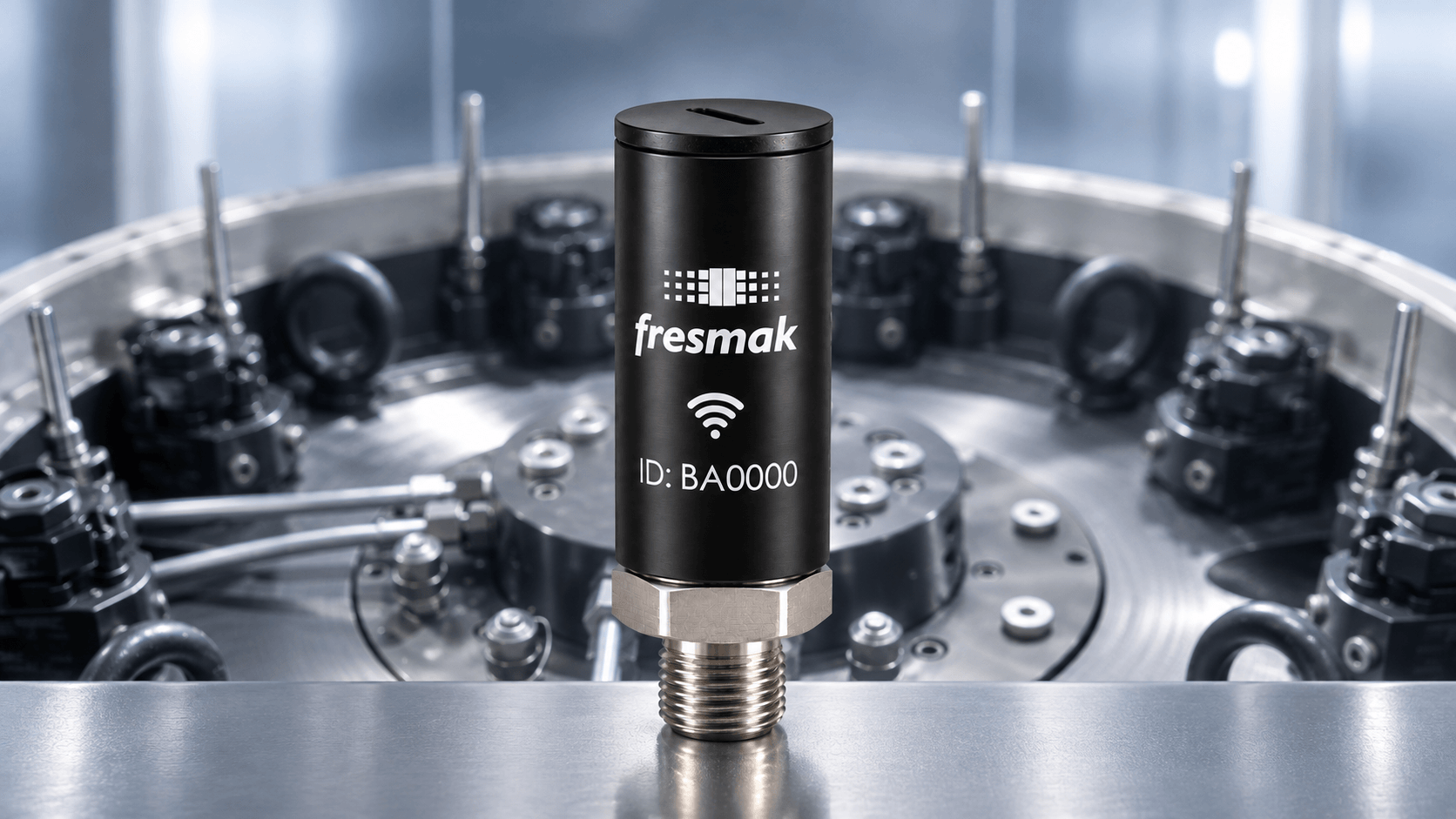
Measure pressure and temperature without running a single cable.
No cables. No weak points.
Traditional pressure sensors require wiring that can be difficult to install and vulnerable to movement, swarf and wear.
Measure pressure wirelessly.
Install the Fresmak sensor directly at the measurement point and transmit pressure and temperature data by radio frequency.
Real-time data.
Alerts.
Compact, sealed and easy to integrate into existing fixtures.
See how it works in a real application
Before we get into the details, see it in action. In under a minute, you can see how the sensor is installed, how it connects to the software and what the real-time pressure reading looks like.
What changes in your plant
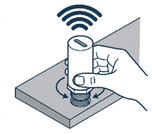
“Plug & Play” installation, with no wiring
Screw in the sensor, connect it to the software, and it starts transmitting data. There are no cable trays to install and no lengthy shutdowns for deployment.
Practical outcome: less installation time and virtually immediate commissioning.

Fewer failures caused by wire breakage
Because there is no physical cable at the measurement point, the risks associated with moving parts, rotating tools or fixtures in machining centres (CNC) are reduced, as conventional wiring is constantly exposed to damage in these environments.
Practical outcome: fewer unplanned stoppages attributable to the measurement system itself.
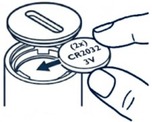
Standard, easy-to-replace batteries
Powered by 2 standard 3V CR2032 batteries, which are widely available and can be replaced by the user in seconds.
Practical outcome: sensor maintenance without relying on a specialized technician or manufacturer-specific parts.

Reliable transmission through enclosed structures
The signal is transmitted by radio frequency and can pass through walls and even enclosed metal structures, making it possible to monitor pressure inside fully enclosed machines.
Practical outcome: you can measure pressure at previously inaccessible points without opening the machine or running cable into the enclosure.

Configurable threshold alerts
Define the warning thresholds for your process and the software notifies you as soon as pressure rises above or falls below them.
Practical outcome: the ability to act before a pressure deviation becomes a breakdown or results in a defective part.

Historical data for preventive maintenance
Data can be exported and analyzed to identify trends.
Practical outcome: helps your maintenance team anticipate abnormal behavior as a complement to an existing maintenance plan.
From installation to the first reading in four steps
1. Physical installation Screw the sensor into the point on the machine, fixture or line where you need to measure pressure. |
2. Software connection Pair the sensor with the monitoring platform. From this point on, data is transmitted wirelessly by radio frequency. |
3. Parameter and threshold configuration Define your process pressure values and the warning thresholds you want to monitor. |
4. Visualization, logging and alerts View pressure and temperature in real time, review historical data and receive a notification if a threshold is exceeded. |
All your pressure points on a single screen
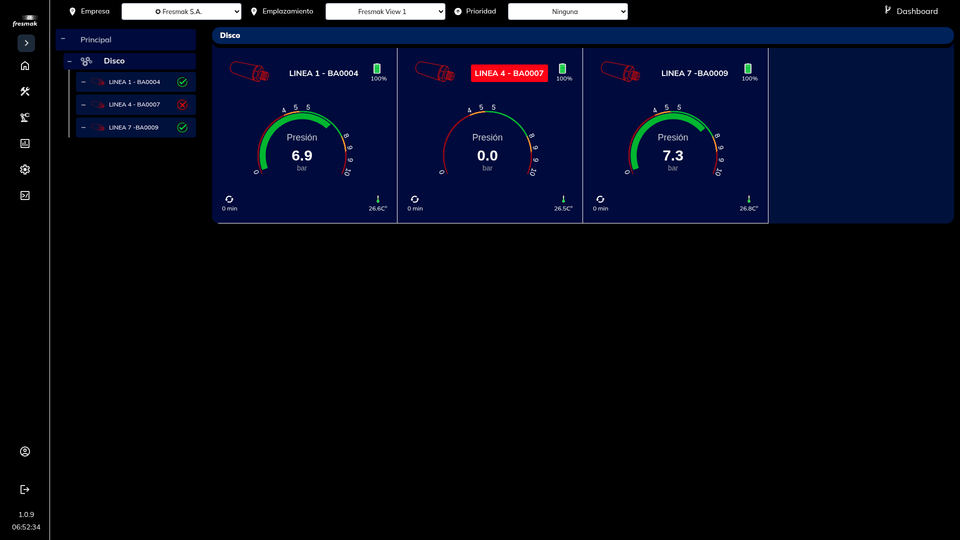
The sensor integrates with Fresmak’s cloud monitoring software, where you can view and analyze data in real time from any device. The dashboard shows the pressure reading for each instrumented point (in bar), organized by line or location, together with battery status and sensor temperature.
You can configure alarms tailored to your process: if pressure rises above or falls below the defined threshold, the system flags it immediately so you can intervene in time.
Historical readings can also be exported for analysis and trend identification. This information supports preventive maintenance by helping detect leaks, gradual pressure drops or abnormal behavior in advance, as a complement to the maintenance team’s analysis.
Designed for the most critical pressure points in your process
Fits into the ecosystem you already have
The sensor is designed to integrate with your existing SCADA, PLC or cloud platforms, without requiring you to replace the control infrastructure already in use at your plant.
For engineering, this means adding a wireless measurement point to the current monitoring architecture. For maintenance teams, it provides direct access to pressure readings from any device. For procurement teams, it provides a solution that integrates into the existing process into the existing process instead of requiring a complete overhaul of the control system.
Frequently asked questions
Not at the measurement point. The sensor transmits data by radio frequency to the software, with no physical cable between the sensor and the reading system.
Yes. This is one of its key applications: robotic arms, rotary tables, rotating tools or industrial vehicles, where conventional wiring is often a critical point of failure.
With 2 standard 3V CR2032 batteries.
Yes. The user can replace them in seconds without relying on a specialized technician.
Yes. The radio-frequency signal can pass through walls and even enclosed metal structures, making it possible to monitor pressure inside fully enclosed machines.
Yes. You can define warning thresholds and the software notifies you as soon as pressure rises above or falls below them.
Yes. Data can be exported and analyzed to identify trends, supporting preventive maintenance.
Yes. The sensor is designed to integrate with existing SCADA, PLC and cloud platforms, so you can add wireless pressure monitoring without replacing your current control infrastructure.
Fixtures and clamping systems, pneumatic networks, hydraulic and pneumatic systems, mobile machinery and robotics, packaging forming and sealing processes, plastic injection molding and pressure vessels.
Tell us where you need to measure pressure
Whether it is a hard-to-reach point, a moving component or an area where wiring is causing problems, our technical team can review your case and tell you whether the wireless sensor is a good fit.

